
Fitch Ratings has removed energy infrastructure company Adani Energy Solutions Ltd (AESL) from its 'Ratings Watch Negative' list, the first upgrade by an international ratings agency since the US indictment. Fitch affirmed AESL long-term foreign and local-currency issuer default ratings (IDRs) at 'BBB-'.

Bihar Chief Minister Nitish Kumar launched a scathing attack on his predecessor Rabri Devi, calling her appointment as Chief Minister "suspension-induced" during a heated debate in the state legislative council. The verbal sparring, marked by accusations and counter-accusations on law and order, saw Kumar accusing the RJD of being unable to handle Hindu-Muslim tensions and engaging in "mischief." Rabri Devi, in response, asserted her right to speak about her achievements during her tenure as Chief Minister. Kumar, however, retorted with a sharp, local phrase, dismissing Rabri Devi's claims. The exchange, which saw both sides engage in mudslinging, ended with the Chairman admonishing the opposition for their unruly behavior.

Ask rediffGURU and PF expert Nitin Narkhede your mutual fund and personal finance-related questions.

Kolkata Knight Riders' new vice-captain Venkatesh Iyer has ventured into the skincare market by launching a range of grooming products and supplements under the brand - Rushr.

Activist short-seller Nathan Anderson, known for his high-profile campaigns against the likes of Adani Group, said he is closing his firm, Hindenburg Research, not because of any threat -- legal or otherwise -- and that he stands by all its reports.

The 31st meeting of the Goods and Services Tax (GST) Council, held in December 2018, deferred a decision to reduce the GST rate for cement from 28 per cent to 18 per cent. This was despite recognising that cement - along with automobile parts - remained among the few mass-consumption items still taxed at the highest slab, which was originally meant for luxury and sin goods.

Real estate developers are hoping that the slew of tax concessions announced in Union Budget 2025, set to take effect this financial year, will spur demand for affordable and mid-segment housing, even as the broader housing market shows signs of fatigue.
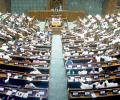
Parliament's approval of the Waqf (Amendment) Bill, a contentious piece of legislation aimed at reforming Waqf bodies, has sparked strong reactions from the opposition, who allege that the bill was "bulldozed" through Parliament. The bill, considered the government's most consequential legislation in its third term, was passed with comfortable majorities in both the Lok Sabha and Rajya Sabha despite opposition claims of a lack of consultation and an intrusion into religious affairs. Other notable bills approved during the session included the Finance Bill, Appropriation Bill, Immigration and Foreigners Bill, and Tribhuvan Sahkari University Bill. The session, which saw high productivity, also witnessed debates on issues such as economic distress, delimitation, and the three-language policy. While the government touted its achievements, the opposition criticized the government's approach and vowed to challenge the Waqf bill in court.

Shares of Bajaj Finance surged over 6 per cent on Thursday after the diversified non-banking finance company reported an 18 per cent increase in consolidated net profit to Rs 4,308 crore for the December quarter. The stock rallied 6.33 per cent intraday to touch Rs 8,249.95 - a 52-week high -- on the BSE.

The TMC-led West Bengal government has already started laying the groundwork for the election, setting the tone with the recent Bengal Global Business Summit and the state Budget.

Defence Minister Rajnath Singh told an all-party meeting that at least 100 terrorists were killed in the Indian strikes on terror sites in Pakistan and Pakistan-occupied Kashmir under 'Operation Sindoor'. Leaders from various parties showed maturity and extended all support to the government and armed forces.

'Could the impending new crisis, vibe coding, similarly create not a disaster like what befell Indian handlooms during the Industrial Revolution but another opportunity like what the Y2K crisis created?' asks Ajit Balakrishnan.

Anmol Singh Jaggi and Puneet Singh Jaggi, once hailed as rising stars in India's clean energy sector, are now facing serious regulatory action.

'You cannot have only one product or one market or one customer segment.'

The "weaponisation" of economic activity - through tariffs and sanctions - is now a reality, with countries leveraging these tools strategically, External Affairs Minister S Jaishankar said at the Raisina Dialogue recently.

Neo banks, along with mid-sized banks, are establishing global capability centres (GCCs) in India, mirroring the expansion strategies of larger global counterparts. This trend is being seen as the next major wave in the country's banking, financial services, and insurance (BFSI) sector.

'The answer is not for me to give. The answer either way has to be heard from the industry itself. Tell us why not if you are not doing it; tell us if you are doing it -- why should this question remain unanswered?'

Singapore's long-ruling People's Action Party (PAP), led by Prime Minister Lawrence Wong, has secured a landslide victory in the country's general election. The PAP won 87 of 97 seats, with voters endorsing the party's focus on stability and economic security amidst global uncertainties. Wong expressed gratitude for the strong mandate and vowed to tackle concerns about the cost of living and housing. The results mark a significant win for the PAP, which has been in power since Singapore's independence in 1965.

Donald Trump is catering to the basest fears and prejudice of unenlightened Americans -- yes, there are those too, in sizeable enough numbers to elect one of their own as president. That would most certainly not Make America Great Again, asserts Shreekant Sambrani.

When Gensol Engineering made its public market debut through a small and medium enterprises (SME) initial public offering (IPO) in September 2019, its promoters held a commanding 96 per cent stake. Now, that figure has shrunk to a "negligible" fraction.

Moody's Ratings on Wednesday said India's economic growth will exceed 6.5 per cent in the next fiscal, up from 6.3 per cent this year, on higher government capex and consumption boost from tax cuts and interest rate reduction. Projecting a stable outlook for the banking sector, Moody's said although the operating environment of Indian banks will remain favourable in the next fiscal, their asset quality will deteriorate moderately after substantial improvements in recent years, with some stress in unsecured retail loans, microfinance loans and small business loans.
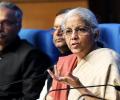
The eighth Budget of Finance Minister Nirmala Sitharaman continued to focus on 'GYAN' (Garib, Youth, Annadata, Nari) to maintain a consistent and coherent strategy initiated over the years in pursuing the government's vision for Viksit Bharat. The approach, characterised by incremental yet impactful steps, aims to create a compounding effect over time.

'ESG is actually a concept which cannot be applied effectively in the very short run.'

10 largecaps stocks which stand to gain from the Budget.

Reliance Industries Ltd on Thursday reported a 7.4 per cent rise in its December quarter net profit, as its retail business rebounded and telecom earnings rose. Its consolidated net profit of Rs 18,540 crore, or Rs 13.70 per share, in October-December - the third quarter of April 2024 to March 2025 fiscal (FY25) - compared to Rs 17,265 crore, or Rs 12.76 a share, in the same period a year back, according to a stock exchange filing by the company.
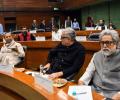
India's Parliament is set to begin its Budget session on Friday, with opposition parties poised to demand a discussion on the alleged mismanagement of the Maha Kumbh festival in Prayagraj, where 30 pilgrims died in a stampede. The opposition also accused the government of politicising parliamentary committees and pushing its agenda through its majority. The session will start with President Droupadi Murmu addressing both houses of Parliament. Finance Minister Nirmala Sitharaman will present the Union Budget on Saturday for the eighth consecutive time.

'Tax rate and stock markets are entirely two different things.'

The government is looking to give Bharat Global Ports a certain amount of domestic exposure after it set up the state-owned consortium to increase India's global maritime heft, officials aware of the development said. The intended domestic exposure is meant to give the consortium experience and build its credentials for international projects.

Fintech firm BharatPe is targeting an initial public offering (IPO) in the next 18-24 months with the company expecting profitability at an earnings before interest, taxes, depreciation and ammotisation (Ebitda) level for FY25, chief executive officer (CEO) Nalin Negi said.

The government on Saturday announced a host of measures such as setting up of a new Fund of Funds Scheme (FFS) with Rs 10,000 crore corpus; and extension of period of incorporation by five years with a view to promote growth of budding entrepreneurs.

As per the Budget memorandum, the government has proposed amendment to Sub-Section 2 of Section 23 of Income Tax Act, which relates to determination of annual value of house properties.

Audi plans to focus the Indian market, including deepening market penetration and increasing sales volume.

The most striking features of this Budget was its focus on simplification and improving the ease of doing business in India, asserts Kaku Nakhate.

The US has sanctioned an Indian national based in the United Arab Emirates and two India-based entities for operating as part of Iran's shadow fleet and involved in shipping Iranian oil. The US Department of the Treasury said Jugwinder Singh Brar, who owns multiple shipping companies, operates as part of Iran's shadow fleet, which the US said is used to evade sanctions and transport Iranian oil. Brar also owns or controls India-based shipping company Global Tankers Private Limited and petrochemical sales company B and P Solutions Private Limited. The sanctions come as part of a US campaign of maximum pressure on Iran and target the country's petroleum and petrochemical sectors.

Cricket climate change to medical practice, dropped candidates have their non-political life sorted.

The underrepresentation of women in the field of artificial intelligence (AI) poses a significant risk of perpetuating the prevailing societal biases into future technologies, according to a top Microsoft executive. Himani Agrawal, chief partner officer, Microsoft India and South Asia, believes that inclusion is a shared responsibility and if AI continues to be shaped without diverse perspectives, the biases of today risk becoming hardwired into the technology of tomorrow.
As a step to entrench its consumer finance business, Bajaj Finance (BFL) plans to scale up its business-to-business (B2B) activity, both in terms of volume as well as value. It plans to add up to 1,000 cities in the next three years and this will mark its presence in around 5,000 cities. The expansion activity will be more in Northern and Eastern India.

The meltdown in Dalal Street that wiped out investor wealth to the tune of 44 trillion in 2025 also seems to be having a ripple effect on the country's vibrant automobile retail sales.
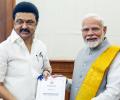
With its age-old fascination for education, southern states have done better than the North. Start-ups, IT hubs, and industry majors setting up shop have changed the face of the South. Nearly 79% of global offices set up by international conglomerates in India are in the South. Almost 46% of tech unicorns are from the South. The GDP per person in the South is 4.2 times higher than the North. None of these indicators can be ignored by any central government, whatever the political compulsions, notes Ramesh Menon.

'Our vision is to become a GenAI managed services provider.'
